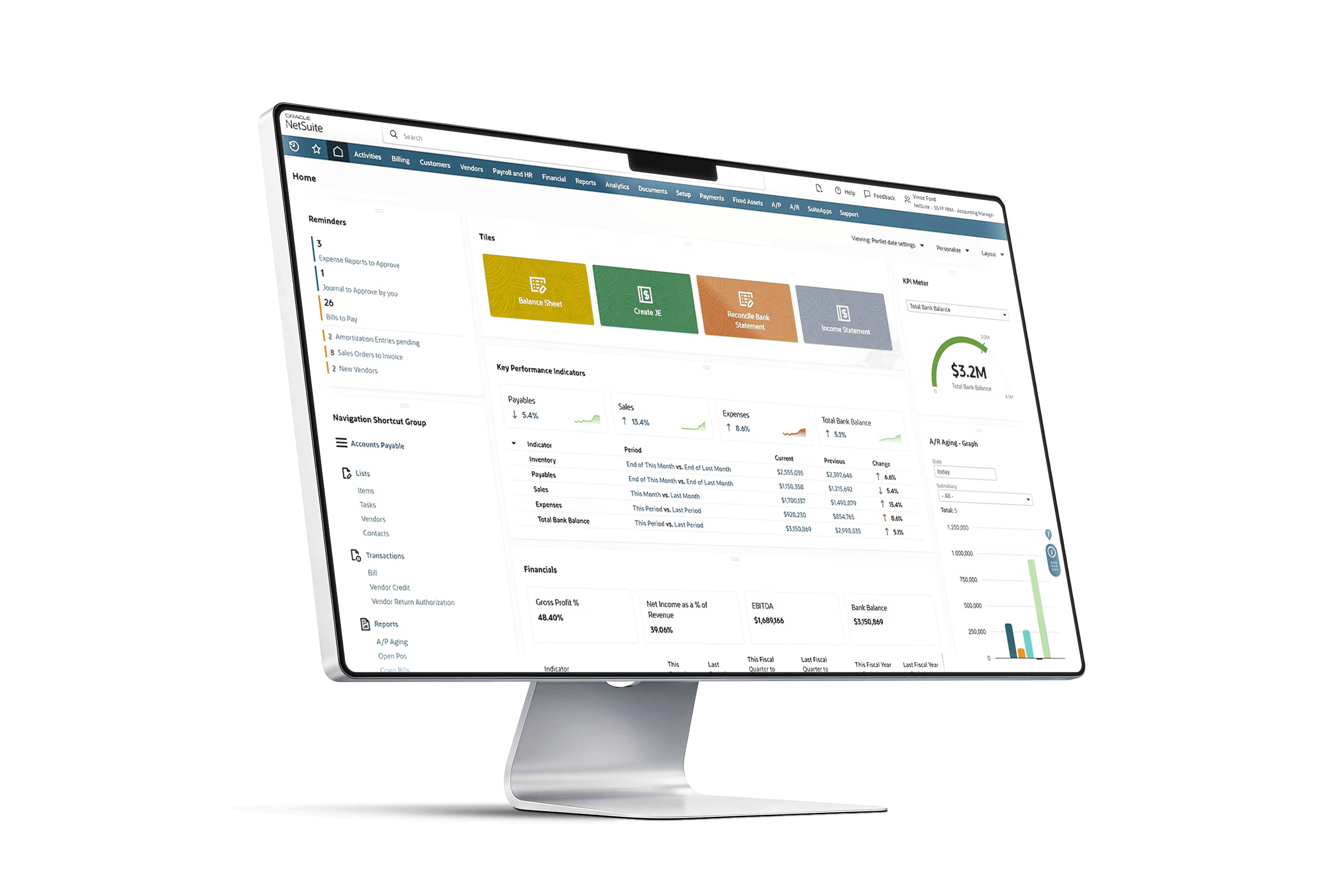
Core financials track what happened, but budget-versus-actual, expense allocations, and amortization schedules are where finance teams often fall back on spreadsheets. NetSuite Advanced Financials brings that work into NetSuite: multiple budgets monitored against actuals in real time, weighted expense allocations, automated amortization, and statistical accounts. Zanovoy implements and configures it to how your finance team actually manages the numbers.

















What It Does

Supports multiple budgets and monitors budget versus actual in real time. Enter budgets on a single screen, copy an existing budget, or build one from actuals with an uplift or downlift, or import from Excel via CSV. The Multiple Budgets feature lets you run and report on more than one budget for the same criteria, a standard budget against a conservative one, or a forecast.

Provides Budget Income Statement and Budget vs. Actual reports, and lets you build your own budget reporting so finance sees performance against plan off-live data rather than a reconciled spreadsheet.

Lets you enter expenses without assigning them to a class, department, or location, then allocate them later by weighted formula, GL account, class, department, and location. Allocation schedules can run once or recur, and dashboard reminders flag active schedules due for processing, which you can post in a single journal entry.

Automates amortization of expenses over time, including prepaid expenses, and links schedules to bills, bill credits, and jobs. Schedules can amortize expenses in proportion to a job's percentage of completion, so the timing follows the work.

Stores critical non-financial values, headcount, floor space, and common shares and uses them to allocate financial activity proportionately, for example, spreading corporate overhead across departments by headcount or rent by square footage. Multiple allocation schedules can run in sequence, and key measures like Net Promoter Score can sit on your dashboard alongside the financials.
See how this would run across your actual budgets and allocations.
Map This to Your NumbersWhat You Get From It
01
Multiple budgets monitored against actuals in real time mean performance against plan is visible continuously, not assembled at month-end, so you catch variances while you can still act on them.
02
Weighted, rule-based allocations replace the manual journal work that invites error, so shared costs spread across departments and locations on consistent logic that the whole finance team can stand behind.
03
Recurring allocation and amortization schedules run on their own, with dashboard reminders and single-click posting, so the repetitive month-end work that slows the close happens automatically.
04
Automated amortization, including job-linked schedules tied to percentage of completion, puts expenses in the right period without manual tracking, so prepaid and long-term costs hit the books when they should.
05
Statistical accounts bring headcount, floor space, and measures like Net Promoter Score into the same system as the financials, so the drivers behind your allocations and the metrics on your dashboard come from one place.
06
Because Advanced Financials extends NetSuite rather than sitting outside it, all of this runs on the same financial data as the rest of your system, so there's nothing to sync and nothing to reconcile between systems.
Get the budgeting and allocation work out of spreadsheets and into the close.
Get Your Setup ScopedWhy Work With Zanovoy on Advanced Financials
Allocations, amortization rules, and budget structures only deliver when they match how your finance team actually manages costs and plans. Set them up wrong, and you get allocation logic no one trusts and budgets that don't tie out. We lead with that configuration work, from the finance seat, so the budgeting, allocations, and amortization run on your real logic and stay tied to the financials.
01
We configure your budgets, allocation formulas, amortization schedules, and statistical accounts to match how you actually manage the numbers, all inside NetSuite, so financial management runs as one system.
02
We support your financial setup after go-live, so issues in allocations, amortization, or budget reporting are handled before they reach your month-end.
03
We handle the path to Advanced Financials, so extending your financial management does not become its own drawn-out project.
04
We configure the module to your actual allocation logic and budget structure, rather than forcing your finance process to fit a generic template.
05
The people who advise on your financial setup are the people who implement it, integrate it, and support it afterward.
06
We tune your budgets, allocations, and amortization rules as your business and reporting needs grow, so the module keeps pace with how finance runs.
Allocations and budgets only deliver when they're configured to how you actually run the numbers.
Get Your Allocations ScopedProfessionals on the Financial Transformation Team
Companies supported through IPO
Implementations delivered across 5 continents
Customizations built for enterprise clients
Integrations built across the platform ecosystem
Continents served
© Copyright 2025, All Rights Reserved by Zanovoy





.png)