

.jpg)
Ember AI is Campfire's branded AI layer and the most-cited feature in early Campfire reviews. This review is based on Campfire's documentation, Anthropic's case study, the Ember Agents launch coverage, and what we have observed deploying the platform. The goal is to answer one question: does it work, and where does it still need human judgment.
What is Ember AI in 60 Seconds?
Ember AI is Campfire's accounting intelligence layer with two product modes: Ember Chat for natural-language finance queries, and Ember Agents for autonomous workflow execution. Chat lets a finance team ask 'what was last quarter's flux on customer acquisition cost' and get an answer with source transactions. Agents handle recurring work like transaction matching, AP/AR processing, accruals, and close package preparation in the background.
Ember Chat went public with Campfire's Series A in June 2025. Ember Agents launched in beta on March 12, 2026 (source: Fortune via EZ Newswire). Both are accessible inside the Campfire platform under role-based controls, with every action logged for audit.
Is Ember AI Actually Powered by Anthropic Claude?
Yes, but the answer needs a footnote. Campfire and Anthropic published a partnership case study confirming Claude powers the Ember chat interface, the automated bank reconciliation, and intelligent data integration (source: claude.com/customers/campfire).
Campfire's engineering team, led by CTO Paul Nichols, built the integration using Anthropic's financial recipes API framework.
The footnote: Ember Agents run on Accounting Intelligence, Campfire's proprietary foundation model (also referenced in industry coverage as a large accounting model, or L.A.M.) trained specifically on accounting data. Campfire describes this as a domain-specific model that understands chart of accounts structure, vendor patterns, and what clean books look like, rather than a general-purpose LLM with a finance prompt.
Practically, the two-layer architecture means ad-hoc questions run on a frontier general model while recurring accounting workflows run on a model built for accounting. That matters for predictability under load and audit defensibility. Generic LLMs hallucinate journal entries. Domain-specific models trained on accounting data are designed not to.
What Does Ember AI Automate Well?
Based on Campfire's documentation, the Anthropic case study, the Ember Agents launch coverage, and customer reviews on G2, Ember performs the following with reliability sufficient for finance team adoption:
- Natural-language queries against financial data. Ember Chat answers questions about revenue, expense, flux, and account balances with linked source transactions and documents. Every response shows its work.
- Transaction categorization and journal classification. The L.A.M. proposes GL classifications for incoming transactions using the company's chart of accounts and vendor history. Accountants review and approve before posting.
- Bank reconciliation. Ember parses bank statements, matches transactions to GL entries, and flags discrepancies. This was one of the first Claude-powered capabilities documented in the partnership.
- Exception and anomaly flagging. Continuous monitoring for duplicate invoices, miscoded accounts, and unusual transaction patterns. Ember surfaces exceptions to a human for review rather than acting silently.
- Period-over-period flux analysis. Ember generates detailed commentary on variances against prior period or budget. G2 reviews cite this as a high-impact time saver during close.
- Accrual identification and journal entry preparation. Per Campfire's product showcase at Benchmarkit, Ember identifies missing accruals against a technical memo and prepares the corresponding journal entries for review.
- Close package preparation. Ember Agents assemble the recurring close checklist artifacts, freeing the controller to focus on review and exception handling.
Where Does Ember AI Still Need Human Judgment?
This is the section vendors rarely write themselves. Ember is good at the work named above. It is not good at, and should not be trusted with, the following without a human in the loop:
- Novel revenue recognition decisions. ASC 606 multi-element arrangements, performance obligation allocation, and standalone selling price estimation often require professional judgment that the model is not positioned to make autonomously. Use Ember to assemble the analysis, not to decide the policy.
- Materiality calls. What counts as material at one company is not the same as at another. Materiality thresholds live in your accounting policy memo, and human review of the threshold itself should not be delegated to the model.
- One-time and unusual transactions. Restructuring entries, M&A-related accruals, impairments, and tax provision adjustments often involve specific facts the model has not seen. The pattern-matching that makes Ember strong on routine work is what makes it weaker on edge cases.
- Audit defense for novel transactions. Ember can generate supporting documentation. It cannot defend the position to your auditor.
- Stakeholder-facing reporting commentary. The flux commentary Ember produces is a strong first draft. It is not board-ready. The CFO and controller still own the narrative.
The right mental model: Ember is the strongest team member you have at running the repetitive work. It is not the controller. The platform's design reflects this: every agent action is logged, attributed, and reviewable, and human approval is the default.
How Does Ember AI Compare to Coupa Navi and NetSuite Next?
These three AI products are often discussed in the same breath. They do different jobs. The comparison below is the honest version, written by an implementation partner of all three.
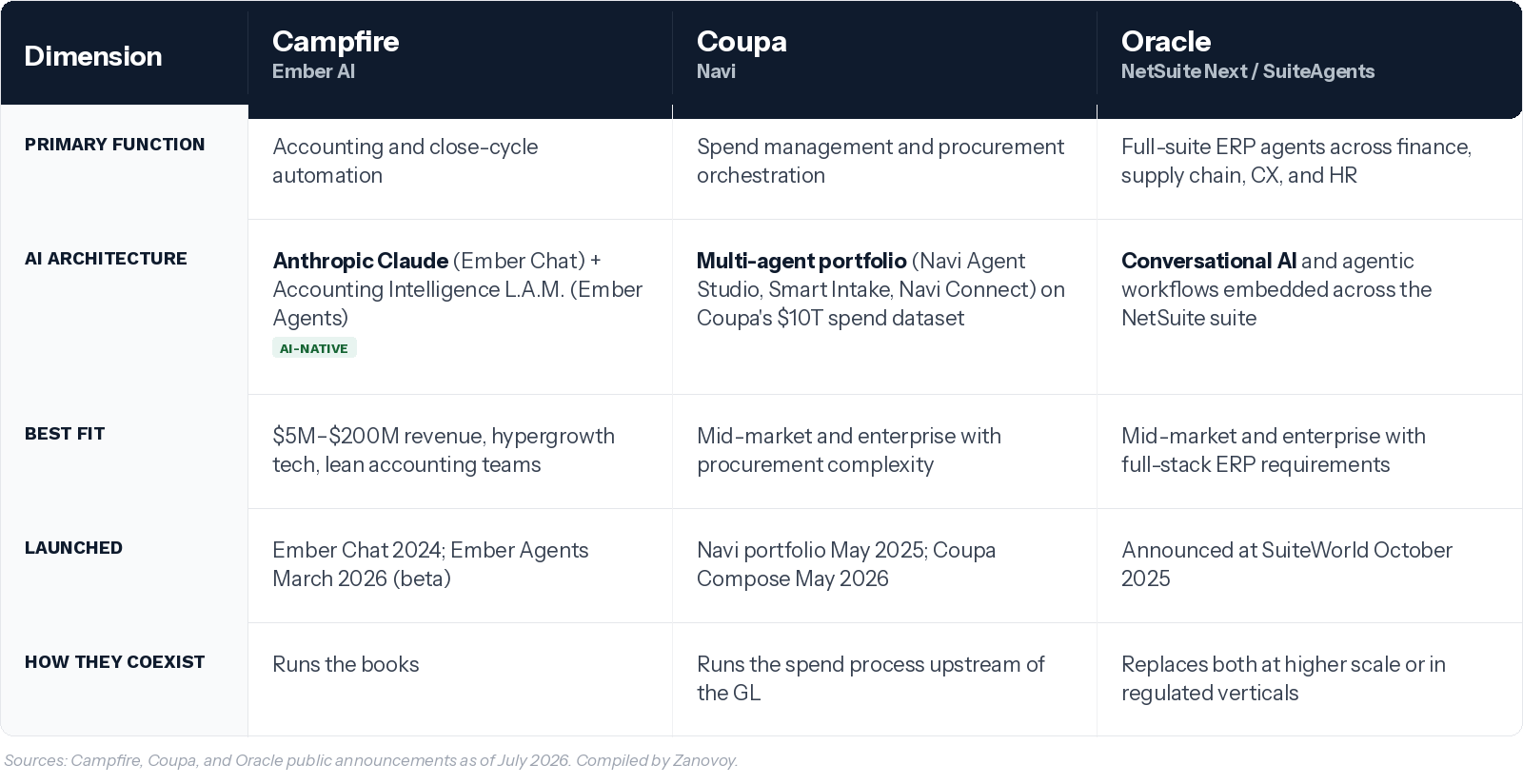
Sources: Coupa Compose launch (PR Newswire, May 12, 2026); Coupa Navi portfolio (Coupa, May 13, 2025); NetSuite Next (Oracle, October 7, 2025); Campfire Ember Agents (Fortune via EZ Newswire, March 12, 2026).
The honest read: Ember AI and Coupa Navi are complementary, not competing. Growth-stage finance teams often run both, with Coupa managing procurement upstream and Campfire running the books downstream. NetSuite Next is the comparable bundle for companies whose scale exceeds Campfire's current target ICP.
How do you Configure Ember AI to Get Useful Output?
Three configuration decisions determine whether Ember performs well or feels frustrating in production:
- Chart of accounts hygiene before agents go live. The L.A.M. learns from your chart structure. A clean, well-named, properly-mapped chart is the prerequisite for accurate categorization. If your chart has 18 catch-all GL accounts from the QuickBooks era, fix that first.
- Permission scoping for autonomous vs review. Ember Agents support a continuum from suggest-only to autonomous-with-audit. Start every workflow in suggest-only mode for the first 30 days. Move to autonomous only after you have evidence the agent is producing the right output on your data.
- Integration sequencing. Campfire ships over 100 native integrations. Sequence the high-volume ones first (banking, billing, payroll) so the GL is populated correctly before activating agents that depend on that data.
The deployment pattern we recommend: a 30-day shadow period with Ember Agents in suggest-only mode against actual transactions; weekly review of agent output against controller expectations; graduated activation of autonomous workflows after explicit sign-off.
What are the Permissioning and Audit Considerations?
This is where Campfire has done meaningful work that distinguishes Ember from a chatbot pointed at a finance database:
- 1,200+ granular permissions across the platform, supporting role-based access at the field, transaction, and workflow level (source: campfire.ai homepage).
- Full audit trails for all AI actions. Every agent decision is logged, attributed, and reviewable, with source attribution that links back to the underlying transaction or document.
- SOC 1 and SOC 2 Type 1 and Type 2 certification (source: campfire.ai/ember).
- Stated policy of no training on customer proprietary data.
- Human-in-the-loop is the default for material actions. Agents can be configured to require explicit approval before posting any entry above a defined threshold.
- Data encryption at rest and in transit, with role-based access controls.
For a pre-IPO finance team, audit-trail design is the headline. Auditors expect AI-generated journal entries to carry the same provenance documentation as human-generated entries. Ember produces that by default. NetSuite Next and Coupa Navi have parallel capabilities, with maturity differences between the three narrow and shrinking.
What is Coming Next for Ember AI?
Three roadmap items are publicly stated:
- General availability of Ember Agents. The launch in March 2026 was a beta release. GA timing has not been published as of the date of this review, but full release is expected during 2026.
- Expansion beyond finance. Per the Anthropic case study, Campfire plans to make Ember available to heads of departments outside finance (sales, engineering, marketing) through integrations with Slack and similar platforms. This would extend Ember's reach from accounting to cross-functional financial visibility.
- Continued L.A.M. development. Campfire's investment thesis from Accel and Ribbit positions the proprietary accounting model as a long-term moat. Expect ongoing model improvement on accounting-specific tasks.
The competitive context is that Oracle NetSuite, Sage Intacct, and Microsoft are all investing heavily in agentic capabilities for the same buyer set. Ember's current advantage is the depth of the accounting-specific model. That advantage is real today. It is not unassailable.
Zanovoy is a Campfire implementation partner, an Oracle NetSuite Alliance Partner, and a Coupa Premier Partner. We deploy Ember AI in production for finance teams and we tell you when Ember is the right fit, when it is not, and what configuration choices determine whether it works.
.png)





.png)